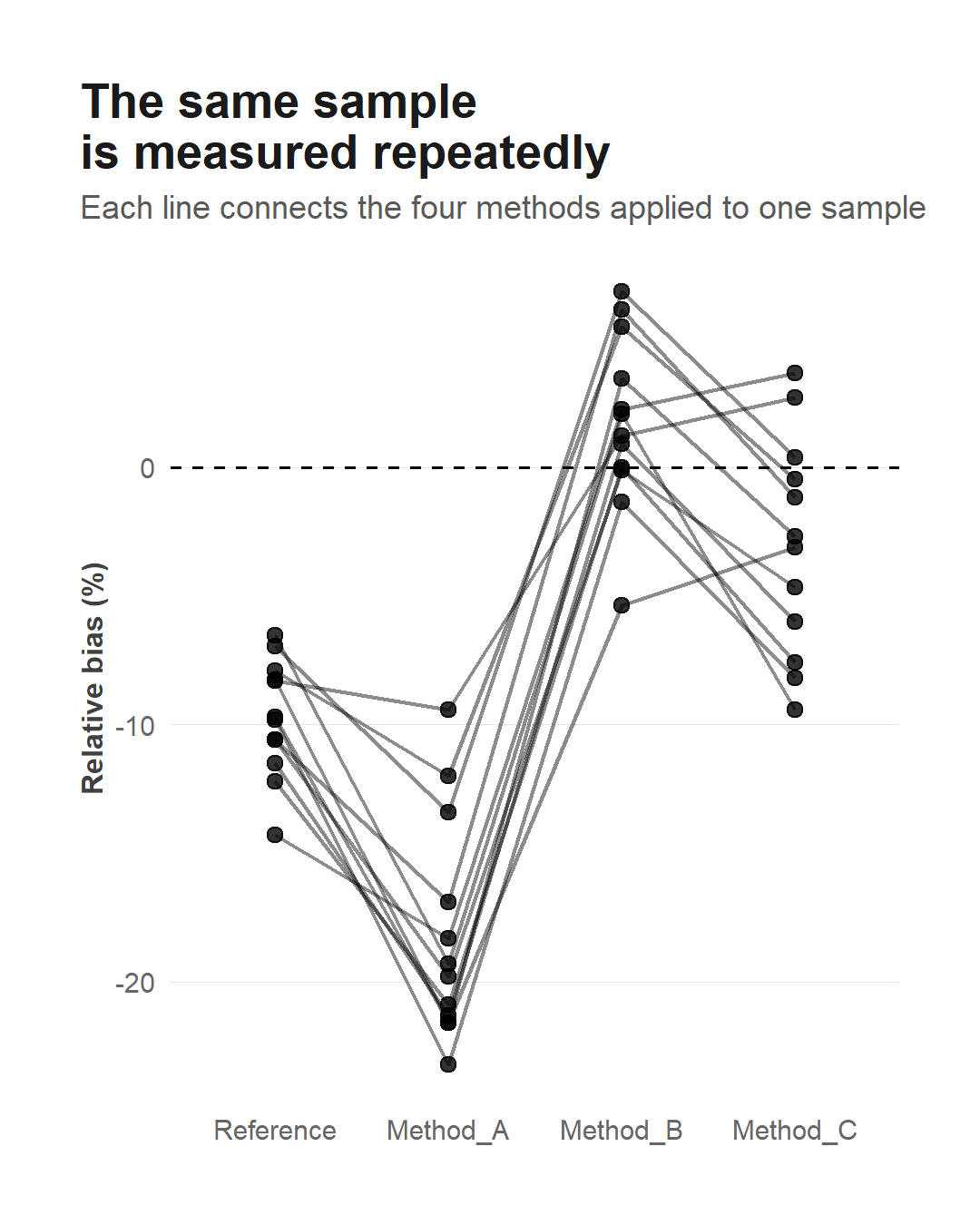
Post 9 — When the same sample is measured four times, what is the observation?
This was probably the point in the project where the experimental design became more important than the ANOVA.
The dataset contains 240 measurements.
But it contains only 60 samples.
Each sample was analysed with all four methods.
That distinction matters.
Method A applied to sample FIL_01 and Method B applied to the same sample share the same physical material.
They are not equivalent to Method A applied to FIL_01 and Method B applied to FIL_12.
The former measurements are linked by the sample itself.
This is the structure of repeated measures.
And it forces us to ask a fundamental question:
What exactly is the independent experimental unit?
If the sample is the unit being compared, then simply treating all 240 measurements as independent can underestimate uncertainty.
A useful way to handle the structure is to analyse the data within sample.
Instead of asking only whether the four sets of observations have different means, we can ask whether the methods differ within the same samples.
This is closely related to the logic of paired comparisons: each sample provides its own reference context.
In analytical chemistry, that can be particularly useful because between-sample heterogeneity can be large.
If one sediment sample naturally produces higher bias than another, comparing methods across different samples mixes method variation with sample variation.
Repeated-measures analysis separates these ideas.
And this leads naturally to the final model of the series.
What if we want the model to represent the sample-specific variation directly, rather than simply conditioning on it through paired comparisons?
That is where mixed-effects models enter.
The implementation details and reproducible analysis for this step are available in the GitHub repository at https://github.com/andreabz/analytical-anova/ and on the project page at https://andreabz.github.io/analytical-anova/