Post 0 — Why I started this project
I have been working with analytical data for long enough to become increasingly suspicious of one particular sentence:
“We ran an ANOVA, and the result was significant.”
The problem is not ANOVA. The problem is everything that can disappear behind those few words.
What exactly are we comparing? What is the experimental unit? Which differences are actually relevant? Does the matrix affect the result? Does the effect of a method depend on the matrix? What happens when the design is unbalanced? Are the model assumptions reasonable? And, perhaps most importantly, would the scientific conclusion survive if some of those assumptions were wrong?
I wanted to explore these questions through a single analytical-chemistry example rather than through a collection of disconnected statistical exercises.
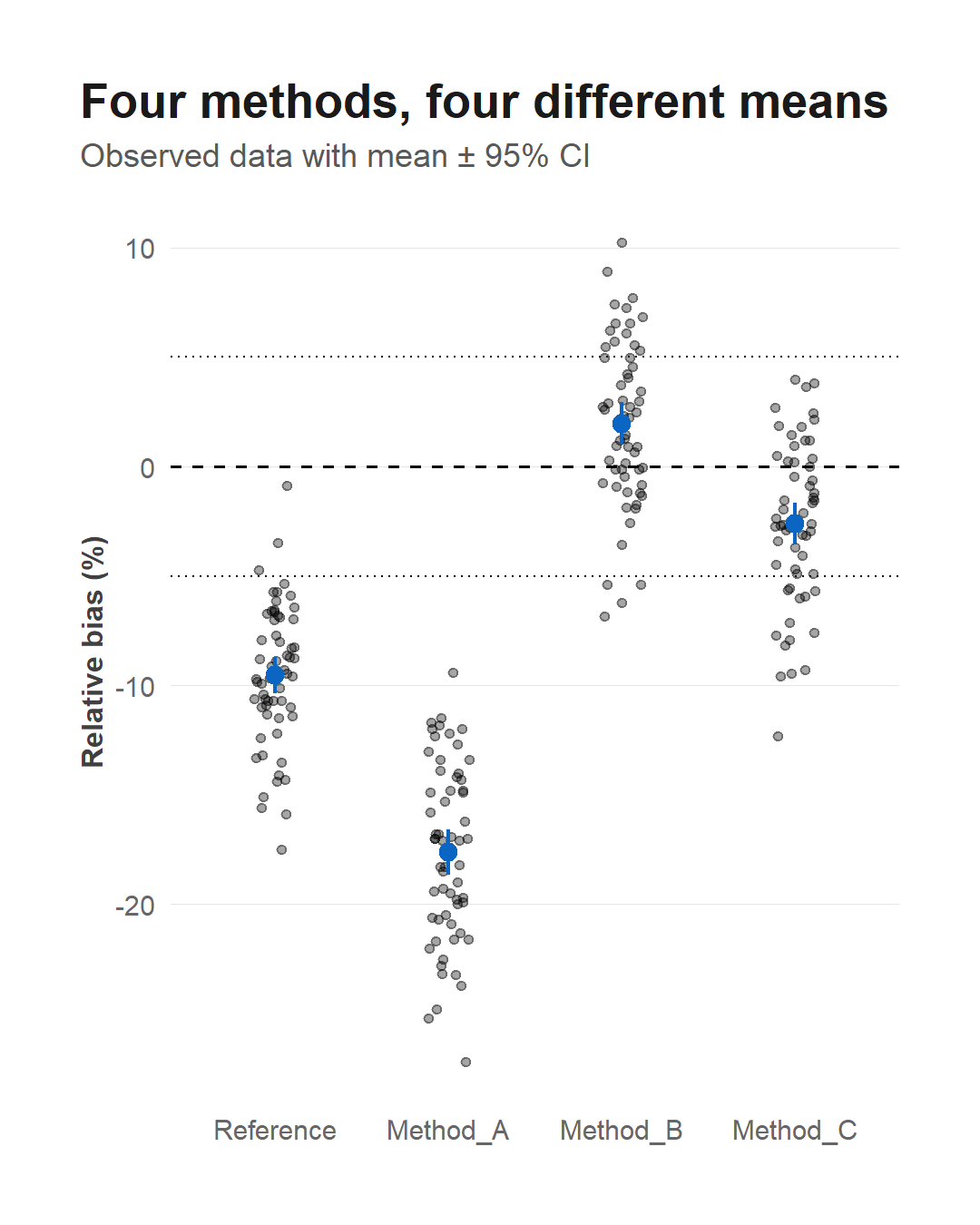
The dataset is deliberately simple: four analytical methods, three environmental matrices, 60 samples and a response expressed as relative bias.
The statistical methods become progressively more complex, but the scientific question remains the starting point.
One-way ANOVA. Contrasts. Two-way ANOVA. Interactions. Unbalanced designs. ANCOVA. Diagnostics. Robustness. Repeated measures. Mixed models.
The objective is not to demonstrate how many statistical techniques can be applied to one dataset.
It is to show something more basic:
the model should change when the scientific question or the experimental structure changes.
That distinction is easy to state and surprisingly easy to forget.
Over the next posts, I will follow the analysis step by step.
Not “which test should I use?”
Rather:
what am I actually trying to learn from these measurements?
The implementation details and reproducible analysis for this step are available in the GitHub repository at https://github.com/andreabz/analytical-anova/ and on the project page at https://andreabz.github.io/analytical-anova/