Post 6 — Correlation can turn a categorical question into a chemical one
At this point we know that Matrix matters.
But “Matrix” is a rather coarse description.
Fill, Soil and Sediment are categories. They do not tell us what property of the samples is actually associated with the change in bias.
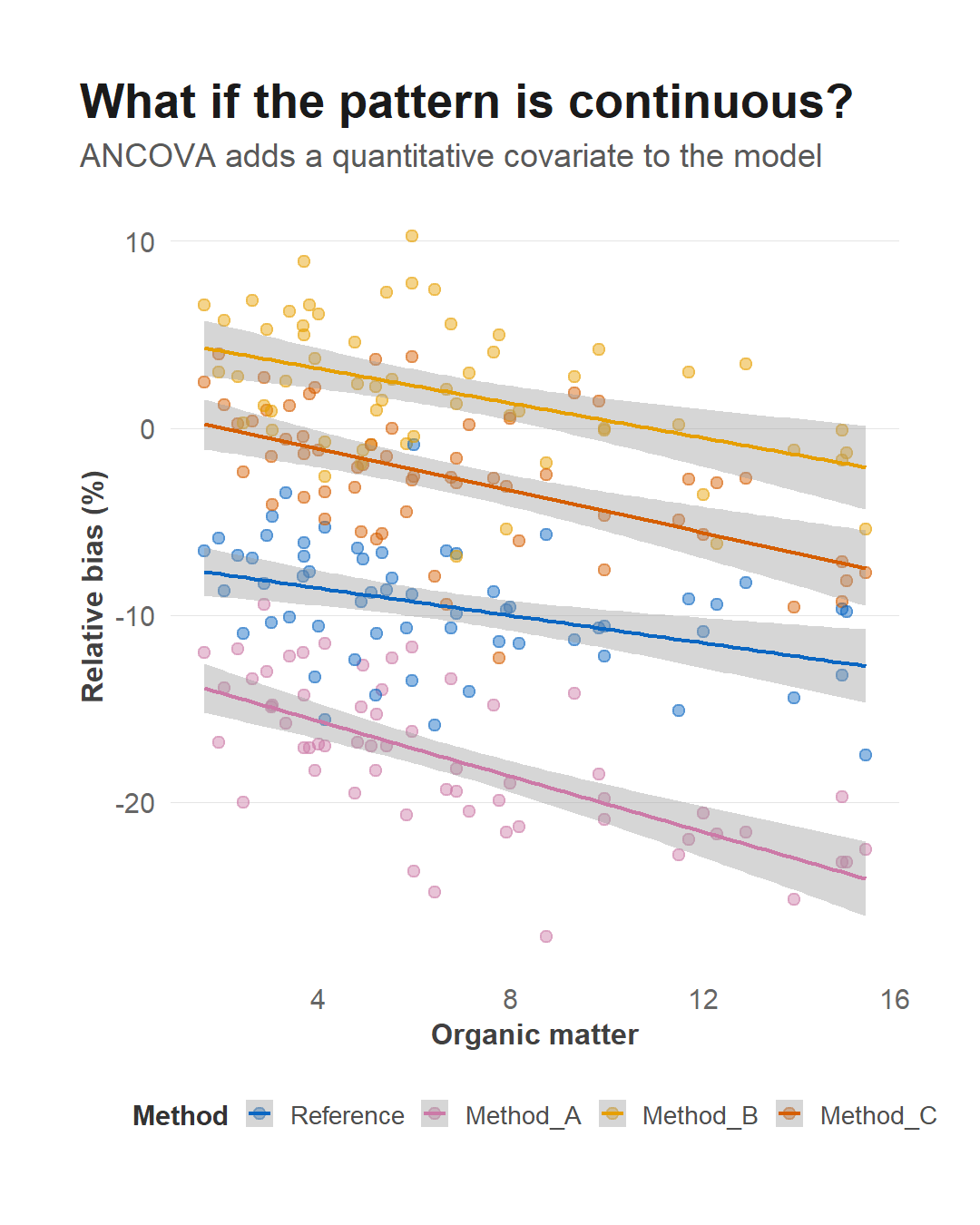
Suppose we also know the organic matter content of each sample.
Now the question becomes:
Does organic matter explain part of the variation in relative bias?
This moves us from ANOVA toward ANCOVA.
The basic idea is simple: combine categorical predictors such as Method and Matrix with a continuous covariate.
But there is an important conceptual step.
We should not automatically assume that organic matter is a “control variable”.
We are asking whether variation in a measurable chemical property is associated with variation in analytical bias.
That makes the covariate scientifically interesting.
It also changes how we interpret the model.
If organic matter is strongly associated with bias, the difference between matrices may partly reflect their different organic matter content.
In other words, Matrix may be acting as a proxy for a more continuous chemical gradient.
This is often closer to how analytical chemistry actually works.
A categorical label such as “Sediment” may be useful operationally, but the analytical interference may depend on a measurable property such as organic matter, ionic strength, particle content or another compositional variable.
ANCOVA does not magically establish causality.
It does something more modest and useful:
it allows us to ask whether a continuous chemical characteristic explains systematic variation that would otherwise remain inside the residuals.
The model is now getting closer to the chemistry.
And that is the direction I wanted this series to take: not more statistical complexity for its own sake, but better descriptions of the process generating the analytical measurements.
The implementation details and reproducible analysis for this step are available in the GitHub repository at https://github.com/andreabz/analytical-anova/ and on the project page at https://andreabz.github.io/analytical-anova/