Post 3 — What changes when the matrix enters the model?
An analytical method does not operate in a vacuum.
Extraction, recovery, interference and signal response can all depend on the sample matrix.
So after comparing the four methods, the next question is straightforward:
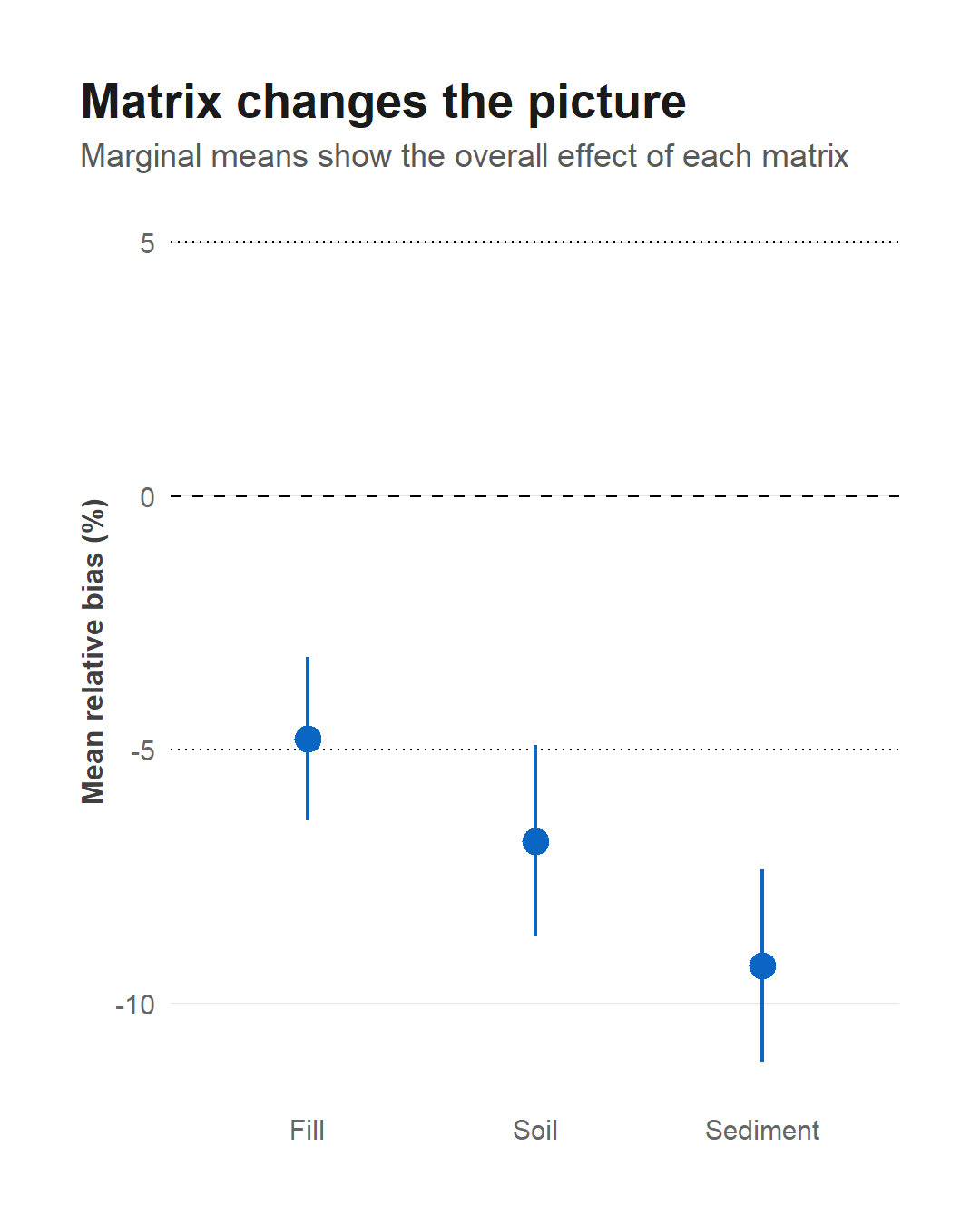
Does Matrix influence relative bias, independently of Method?
The dataset contains three matrices: Fill, Soil and Sediment.
Adding Matrix to the model gives us a two-way ANOVA:
RelativeBias_pct ~ Method + Matrix
In the balanced design, this has a useful property: the effects are orthogonal. Method and Matrix can be interpreted cleanly without the ambiguity that appears in unbalanced designs.
Both effects are highly significant.
But the more interesting point is conceptual.
Adding Matrix changes the question from:
“Do the methods differ?”
to:
“Do the methods differ after accounting for the matrix?”
That distinction matters in method evaluation.
A method that appears to perform differently across samples may be showing a genuine method effect, a matrix effect, or some combination of both.
The model helps separate those sources of variation.
And the chemistry gives us a reason to expect Matrix to matter in the first place.
This is also why I think “ANOVA” is an insufficient description of an analysis.
The same word can hide very different scientific questions.
One factor asks one question.
Two factors ask another.
And the moment we introduce a second factor, we have to ask whether its effect is actually additive.
That is where the next problem appears.
What if the effect of Method itself depends on Matrix?
The implementation details and reproducible analysis for this step are available in the GitHub repository at https://github.com/andreabz/analytical-anova/ and on the project page at https://andreabz.github.io/analytical-anova/